As we celebrate our 65th anniversary, it’s worth asking: how did we go from a single C.P. Huntington Train to the Electric E-Tram™, and everything in between?
The answer begins with one person’s vision and determination.
Meet Harold Chance.
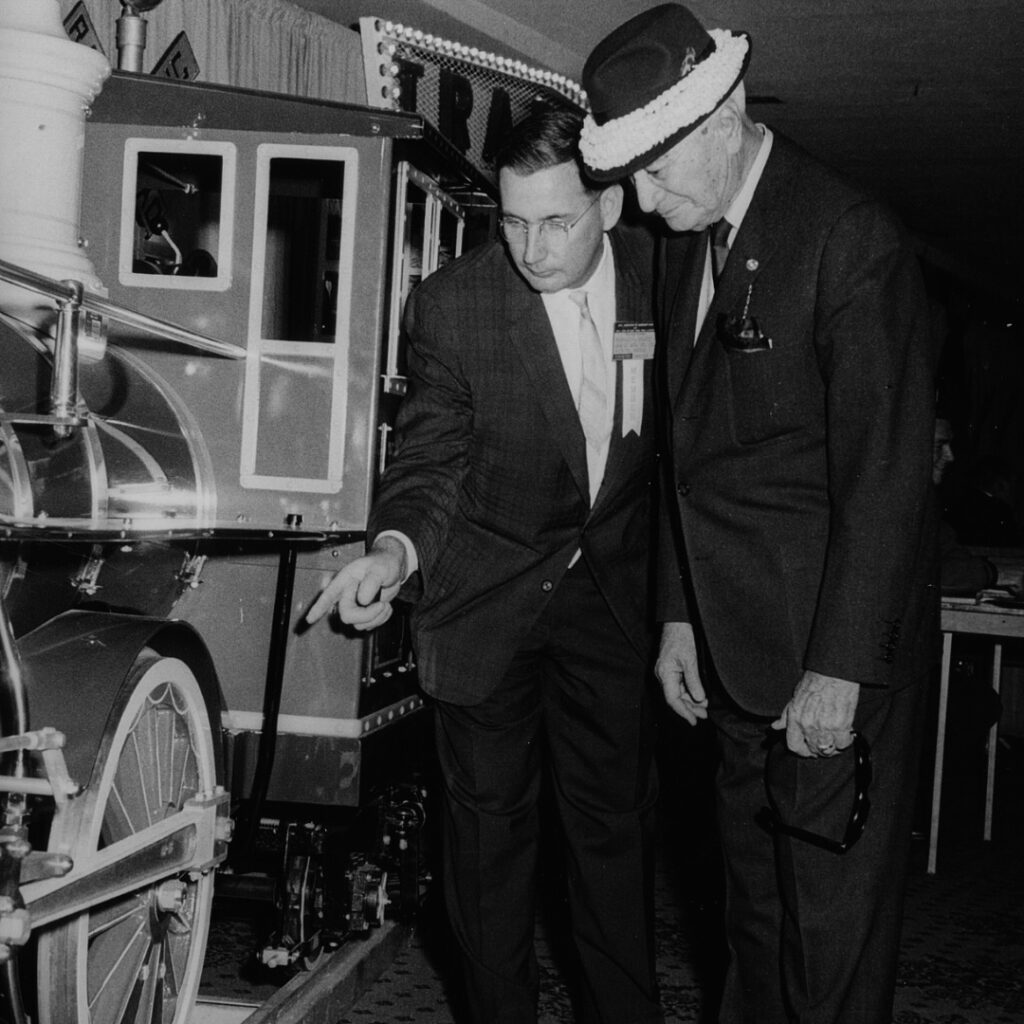 As a young boy, Harold had seen his father working on cars and motorcycles, and that inspiration stayed with him; he was destined to make history. In 1946, after completing his military service, 25-year-old Harold returned to Wichita, Kansas, and went to work for the Ottaway Amusement Company small operation building miniature steam-powered trains for parks and carnivals.
Harold quickly proved himself, becoming factory manager while the Ottaways also operated Joyland Amusement Park, a growing regional attraction. At the time, miniature trains were popular, but far from practical. Steam-powered models were labor-intensive, costly, and difficult to operate. Harold saw the challenges, and he saw the opportunity to do better.
By 1950, when Joyland moved to its permanent location on South Hillside in Wichita, Harold had taken over manufacturing operations. Under his leadership, the company transitioned from steam-powered trains to gasoline-powered models, dramatically improving reliability and ease of use.
During this period, several key rides were developed, including the Aerotrain and the iconic C.P. Huntington Train, modeled after a Civil War-era locomotive. Many C.P. Huntington trains from the 1960s are still running today, a lasting testament to the durability Harold believed in from the beginning.
At the same time, Harold wasn’t just manufacturing rides; he was operating on them. He ran a 10-ride traveling carnival across Kansas, Nebraska, Oklahoma, and New Mexico, with stops as far as Rockaway Beach, Missouri, and Muskogee, Oklahoma. Life on the road exposed a major industry problem firsthand: rides were difficult to transport, slow to set up, and even slower to tear down. That frustration would spark his most influential ideas.
In 1961, Harold went into manufacturing full-time and officially formed Chance Manufacturing Company, Inc. He set up shop at 4219 Irving in Wichita, working out of an 8,000-square-foot building on one acre of land, with just six employees.
From day one, the company’s focus was clear: realism, durability, and practicality. The slogan said it best: “Designed for realism; built to last.”
The C.P. Huntington train became Chance’s flagship product, a one-third-scale replica of an 1863 Central Pacific Railroad locomotive, and helped establish the company as a serious force in the amusement industry.
Harold’s biggest breakthrough came from a simple but radical idea: rides shouldn’t take days to set up. In 1963, Chance Manufacturing acquired the rights to a European ride called the Trabant. Harold reengineered it, mounting the ride on a trailer. The impact was revolutionary; the setup time dropped from three days to just three hours.
This trailer-mounted concept became a defining part of Chance rides and set the company apart from competitors. Growth followed quickly. By the mid-1960s, Chance Manufacturing had expanded to 62 employees and earned a reputation for quality, safety, portability, and fast conversion.
By the early 1970s, Chance had become one of the most influential names in the amusement ride industry. But at its core, Chance Rides has never been just about machines; it’s about understanding how rides are built, moved, and operated.
Harold Chance was a hands-on builder who understood both sides of the business. He solved real-world problems with practical innovation, and that mindset still defines the company today.
From the first miniature trains to modern Electric Trams™, Chance Rides was built on the same principles that guided Harold from the start: innovation with purpose and durability by design for the builders and riders. That legacy continues to move us forward, 65 years later.